

Every clinic claims to care. Every brochure promises results. But when you’re living with persistent back pain, a foot condition that won’t heal, or recovering from spinal surgery — you need more than promises. You need a team that truly understands your condition, your body, and your life. That’s exactly what Centre for Spine and Foot Care was built to deliver.
This isn’t a story about what we do. It’s a story about how we do it — and why that difference changes everything for your recovery.
What Makes Most Clinics Fall Short
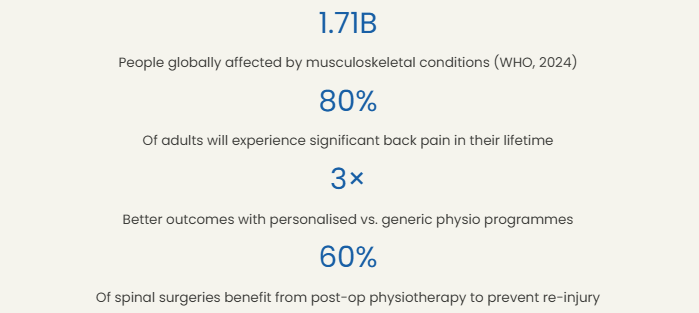
Here’s a reality most clinics won’t admit: the standard model of physiotherapy — arrive, apply heat, do generic exercises, leave — is failing patients. Research from the World Health Organization shows that musculoskeletal conditions affect 1.71 billion people globally, yet treatment outcomes remain inconsistent because care is too often generic, rushed, and reactive rather than personalised and preventive.
Patients with physiotherapy for spinal cord pain need a fundamentally different approach — one that addresses nerve sensitivity, motor function, and lifestyle together. Yet most clinics treat spine pain like a simple muscle strain.
Why We Are Different: The Centre for Spine and Foot Care Philosophy
Our approach is built on four pillars that separate us from every other clinic in the region.
1. We Treat the Root Cause, Not Just the Symptom
When a patient walks in with chronic heel pain, most clinics treat the heel. We ask: why is the heel hurting? Is it gait? Spinal alignment? Weak glutes transferring load to the foot? Our assessments connect the full kinetic chain — from your lumbar vertebrae to your plantar fascia — because the body doesn’t work in isolated parts.
This is especially critical for spinal cord physiotherapy, where the nervous system, postural muscles, and movement patterns are all interrelated. A problem at L4–L5 can manifest as knee pain, hip tightness, or even flat feet. We find the source.
2. Specialist Expertise in Both Spine and Foot Conditions
Most clinics are generalists. We are not. Our team carries advanced training specifically in spinal rehabilitation and podiatric physiotherapy — two areas that are rarely combined under one roof. This dual specialisation means patients who have both back problems and foot-related issues — which is more common than most people realise — receive integrated care rather than being shuttled between departments or clinics.
“I had been managing lower back pain for three years and had seen four different specialists. Within six weeks at Centre for Spine and Foot Care, I understood my condition better than ever before — and I was back to walking 5km a day without pain.”
— Ramesh S., 54, Retired Engineer, Indore
3. Evidence-Based, Technology-Supported Rehabilitation
We combine hands-on clinical expertise with the latest rehabilitation technology. From real-time gait analysis to electrotherapy-supported spinal cord physiotherapy protocols, our treatments are grounded in published clinical research — not tradition or habit. We review our protocols regularly against the latest guidelines from bodies like the Australian Physiotherapy Association and international spine health research.
4. Personalised Recovery Plans — Built Around Your Life
Your recovery plan should fit your job, your daily routine, and your goals. A construction worker recovering from a spinal injury has different needs than a software professional with a sedentary lifestyle. We build care plans that account for real-world constraints, so you can actually follow through — and see results.
“After my spinal fusion surgery, I was nervous about starting physio. The team here explained every step, customised my programme around my office job, and I returned to work two weeks ahead of schedule.”
— Anita K., 42, HR Manager, Bhopal
How We Approach Spinal Surgery Physiotherapy
Post-operative care is one of the most critical — and most neglected — phases of spinal recovery. Spinal surgery physiotherapy is not simply “getting you moving again.” It is a carefully staged process that protects surgical repairs while rebuilding strength, flexibility, and neuromuscular control.
According to a study published in the Spine-Health Journal, patients who complete a structured physiotherapy programme after spinal surgery recover significantly faster and have lower rates of re-injury compared to those who rest without guided rehabilitation.
Our spinal surgery physiotherapy protocol is divided into four phases:
Our 4-Phase Spinal Surgery Recovery Protocol
- Phase 1 (Weeks 1–2): Pain and inflammation management, safe mobilisation, breathing exercises
- Phase 2 (Weeks 3–6): Core stabilisation, postural re-education, gentle range-of-motion work
- Phase 3 (Weeks 7–12): Strength building, functional movement training, return-to-activity planning
- Phase 4 (Month 4+): Performance optimisation, long-term injury prevention, lifestyle integration
Physiotherapy Exercises for Spinal Cord Injury: What Actually Works
Recovering from a spinal cord injury is one of the most challenging journeys a patient can face — physically, emotionally, and psychologically. The right physiotherapy exercises for spinal cord injury can dramatically improve mobility, independence, and quality of life, even years after injury.
Evidence from the National Institutes of Health (NIH) confirms that consistent, progressive physiotherapy exercises for spinal cord injury improve motor function, reduce secondary complications like pressure sores, and enhance psychological wellbeing in patients at all levels of injury severity.
At Centre for Spine and Foot Care, our SCI-specific programmes include:
Key physiotherapy exercises for spinal cord injury we use
- Assisted standing and weight-bearing: Activates lower limb musculature and improves bone density
- Functional electrical stimulation (FES): Stimulates paralysed muscle groups to maintain mass and circulation
- Aquatic therapy: Reduces gravitational load while allowing active movement practice
- Respiratory physiotherapy: Critical for high-level SCI patients to prevent pulmonary complications
- Proprioceptive training: Rebuilds the nervous system’s spatial awareness and balance control
“My son suffered an incomplete spinal cord injury in a road accident. The team here gave us hope when other clinics told us to ‘wait and see.’ Within four months of consistent physiotherapy, he took his first unaided steps. We will never forget that day.”
— Sunita P., Parent of SCI Patient, Ujjain
Tips: How to Get the Most Out of Your Physiotherapy Journey
5 things every patient should do for faster recovery
- Be honest about your pain levels — don’t minimise or exaggerate. Your physiotherapist needs accurate data.
- Do your home exercises — in-clinic sessions are catalysts; home practice is where recovery truly happens.
- Communicate lifestyle changes — a new job, stress, or poor sleep all affect your physical recovery.
- Ask “why” not just “what” — understanding your condition makes you a better participant in your own healing.
- Trust the process — real recovery is rarely linear. Progress can feel slow before it becomes obvious.
The Bottom Line: You Deserve Specialised Care
There are many physiotherapy clinics. There is only one Centre for Spine and Foot Care. We exist because general care is not enough for the complex, connected, deeply personal challenges that spinal and foot conditions present. Whether you are managing physiotherapy for spinal cord pain, recovering post-surgery with spinal surgery physiotherapy, progressing through physiotherapy exercises for spinal cord injury, or simply looking for a clinic that will finally get to the root of your problem — you have found the right place.
Your spine and your feet carry you through every day of your life. They deserve care that is as specialised, thoughtful, and dedicated as you are.



FAQ
1 What is spinal cord physiotherapy and who is it for?
Spinal cord physiotherapy is a specialised form of rehabilitation focused on restoring movement, reducing pain, and rebuilding function after spinal cord injuries, surgeries, or chronic conditions. It is designed for anyone experiencing persistent back pain, disc problems, post-surgical stiffness, or nerve-related symptoms. At Centre for Spine and Foot Care, our spinal cord physiotherapy programmes are fully personalised — built around your diagnosis, your body, and your daily life.
2 How does physiotherapy for spinal cord pain actually work?
Physiotherapy for spinal cord pain works by combining targeted manual therapy, corrective exercises, and neurological rehabilitation to address the root cause of pain — not just the symptoms. Our specialists assess your posture, movement patterns, and nerve function to design a treatment plan that progressively restores mobility and reduces pain. Spinal cord physiotherapy may also include dry needling, traction therapy, and activity-specific training depending on your condition.
3 How many sessions of spinal cord physiotherapy will I need?
The number of sessions varies depending on the severity of your condition and your recovery goals. For mild to moderate spinal cord pain, most patients see significant improvement within 6–10 sessions of structured spinal cord physiotherapy. Complex cases such as post-surgical recovery or long-standing nerve damage may require a longer programme. After your initial assessment at Centre for Spine and Foot Care, your physiotherapist will give you a clear, realistic treatment timeline.