
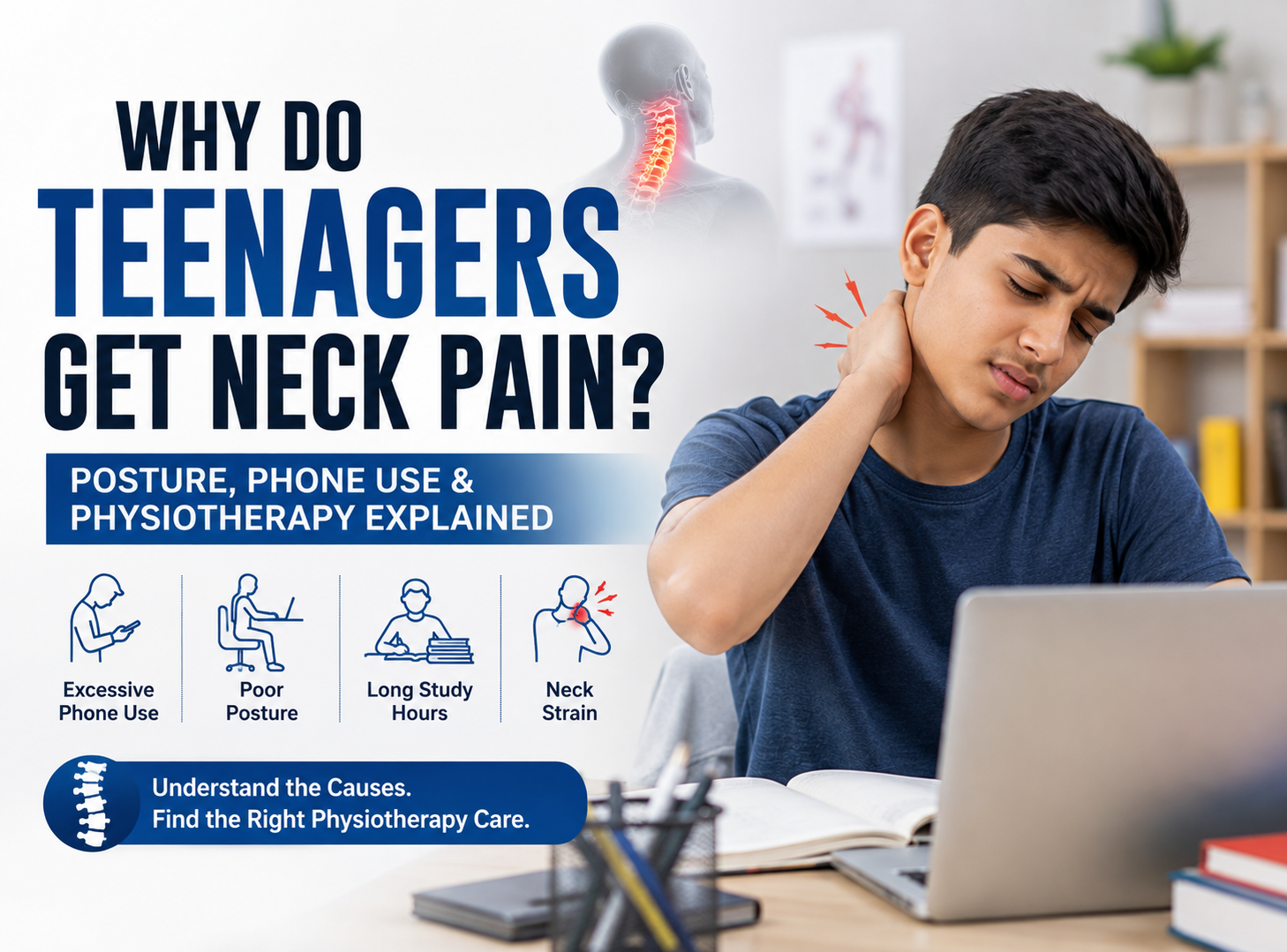
Neck pain is no longer something we associate only with older adults. Teenagers and young adults now spend long hours studying, using laptops, scrolling on smartphones, gaming and attending online classes. Over time, staying in one position for too long can contribute to neck discomfort, stiffness and reduced movement.
But is your phone really causing your neck pain? Is poor posture always the reason? And when should you consider physiotherapy for neck pain?
The answer is more nuanced than simply blaming “text neck.”
Research in young adults has not consistently shown that smartphone use or a particular neck posture directly causes neck pain in every person. However, studies in adolescents have found that smartphone use can be associated with changes in head and cervical posture. This means screen habits are worth looking at, but they should not automatically be considered the sole cause of someone’s pain.

What Causes Neck Pain in Teenagers and Young Adults?
Neck pain at this age can have several possible contributors.
Common factors include:
- Spending long periods studying or using a laptop
- Holding a smartphone low for extended periods
- Remaining in the same position without movement breaks
- Poorly adjusted study or workstation setup
- Muscle fatigue or strain
- Sports-related injuries
- Sudden movements or falls
- Stress and muscle tension
- Previous neck or shoulder injuries
Instead of assuming that posture is the problem, a physiotherapist can assess your symptoms, movement, strength and daily activities to understand what may be contributing to the problem.
Can Phone Use Really Cause “Text Neck”?
You have probably heard the term text neck used frequently on social media.
It generally refers to neck discomfort associated with prolonged device use and sustained positions.
However, it is important not to oversimplify the relationship.
One study involving 18–21-year-olds found no significant association between assessed neck posture during smartphone use and neck pain. Another study involving adolescents found that smartphone use was associated with increased head anteriorisation, suggesting that device use can influence cervical posture even though posture alone does not explain every case of neck pain.
The practical takeaway?
Don’t panic about using your phone. Pay attention to how long you stay in one position, how frequently you move and whether your symptoms persist.
How Study Posture Can Affect Your Neck
Imagine studying for three hours without getting up.
Your head stays in almost the same position. Your shoulders may gradually round forward. You may lean towards the laptop or book. Eventually, your neck and upper-back muscles may feel tired or uncomfortable.
This doesn’t mean that one “bad posture” has damaged your spine.
Instead, the bigger issue may be prolonged static positioning and insufficient movement throughout the day.
Try to:
- Change position regularly.
- Take short movement breaks.
- Keep your study screen at a comfortable height.
- Avoid keeping your phone continuously below eye level.
- Support your back while studying.
- Include regular physical activity outside study time.
When Is Neck Pain More Than a Posture Problem?
Not every neck problem is simply muscular tension.
If your neck pain is persistent, keeps returning or begins affecting your normal activities, it is worth getting assessed.
Symptoms that deserve professional attention can include:
- Pain that travels from the neck into the shoulder or arm
- Tingling or numbness
- Weakness in an arm or hand
- Significant restriction of neck movement
- Pain following a sports injury, fall or accident
- Persistent headaches associated with neck symptoms
- Symptoms that are getting worse rather than better
These symptoms do not automatically mean that you have a serious cervical condition. They simply mean that guessing the cause from an Instagram reel or online exercise video isn’t the best approach.
What Is Cervical Radiculopathy?
Cervical radiculopathy occurs when a nerve root in the neck becomes irritated or compressed.
Unlike ordinary muscular neck discomfort, cervical radiculopathy can involve symptoms that extend from the neck towards the shoulder, arm or hand.
Possible symptoms may include:
- Neck pain
- Arm pain
- Tingling
- Numbness
- Weakness
If these symptoms occur, a professional assessment is important.
Depending on the individual diagnosis, cervical radiculopathy physical therapy may form part of conservative management. Treatment can involve education, appropriate exercises, movement-based rehabilitation and other physiotherapy approaches selected according to the person’s presentation.
It is important not to search for “cervical radiculopathy treatment” and simply copy exercises from the internet. The right treatment depends on the underlying cause and clinical findings.
What Is Cervical Spondylosis?
Cervical spondylosis refers to age-related changes affecting structures in the cervical spine.
It is more commonly seen in adults, particularly with increasing age, and many people with cervical spondylosis may have no symptoms at all. When symptoms do occur, they can include neck or shoulder pain and stiffness, and sometimes headaches that begin around the back of the neck.
Therefore, cervical spondylosis should not be presented as the usual explanation for neck pain in teenagers.
However, adults who search for cervical spondylosis physiotherapy treatment may benefit from a proper assessment to determine whether physiotherapy is appropriate for their symptoms.
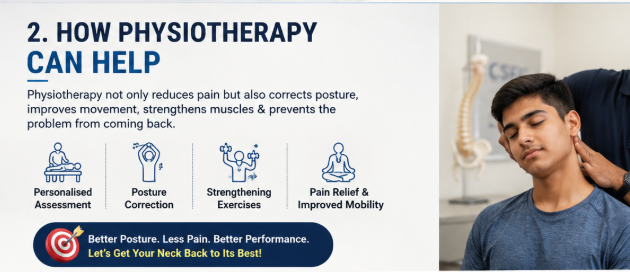
What Does Cervical Physiotherapy Involve?
Cervical physiotherapy is not simply about massage or telling someone to “sit straight.”
A physiotherapy assessment may look at:
- Neck movement
- Shoulder and upper-back movement
- Muscle strength
- Movement patterns
- Work/study habits
- Symptoms and their behaviour
- Previous injuries
- Functional limitations
Depending on the assessment, treatment may include education, therapeutic exercise, mobility work, strengthening, manual techniques or other appropriate interventions.
For someone experiencing ongoing neck symptoms, physiotherapy for neck pain should be individualised rather than based on a generic exercise routine.
Physiotherapy for Neck Pain in Indore
If neck pain is interfering with studying, working, exercising or everyday activities, getting the cause assessed can be more useful than repeatedly trying random exercises.
CSFC provides physiotherapy care for neck and cervical pain in Indore, with treatment planned according to the individual’s symptoms and assessment.
For more information about the service, visit Physiotherapy for Neck Pain & Cervical Pain in Indore.
What Can Teenagers Do to Reduce Neck Strain While Studying?
You don’t need to maintain one “perfect posture” all day.
Instead, focus on comfortable posture + regular movement.
1. Take Movement Breaks
Don’t remain seated for hours continuously.
Stand up, walk around and change position regularly.
2. Bring the Screen to a Comfortable Height
Avoid spending long periods with your head continuously bent towards your lap.
3. Avoid Studying in One Position for Too Long
Even a good posture can become uncomfortable if you maintain it without movement for a long time.
4. Strengthen the Body
Regular physical activity and appropriate strengthening can support overall movement capacity.
5. Don’t Ignore Persistent Symptoms
If pain keeps returning despite changing your routine, consider professional assessment rather than continually changing exercises.
What Exercises Help Neck Pain?
There isn’t one exercise that is appropriate for every person with neck pain.
Depending on the assessment, a physiotherapist may prescribe exercises targeting areas such as:
- Cervical mobility
- Deep neck flexor control
- Shoulder blade control
- Upper-back mobility
- Neck and shoulder strengthening
- General physical conditioning
Young people should not automatically perform exercises labelled “cervical radiculopathy exercises” or “cervical spondylosis exercises” simply because they have neck pain.
The exercise should match the actual problem.
When Should You See a Physiotherapist for Neck Pain?
Consider a professional assessment if:
- Your neck pain persists or repeatedly returns.
- Pain interferes with studying, sleep, sport or daily activities.
- You have pain extending into the arm.
- You experience tingling or numbness.
- You notice weakness.
- Your symptoms started after an injury.
- You are unsure which exercises are appropriate.
For teenagers, parents should also pay attention when a child repeatedly complains of neck pain, headaches or difficulty participating in normal activities.
What Our Patients Say
Patient Review
After a thorough initial assessment, they created a personalized treatment plan tailored to my shoulder injury. The targeted exercises were easy to follow and incredibly effective. Within just a few weeks, I noticed a huge improvement in my daily activities and can finally cook and drive comfortably again! .
Another Patient Experience
From the comprehensive assessment to my customized exercises, every step of the personalized treatment felt targeted to my needs. The progress has been fantastic. I’ve seen a massive improvement in daily activities like carrying groceries and walking pain-free. I couldn’t be happier with the results!
Final Takeaway
Neck pain in teenagers and young adults shouldn’t automatically be blamed on smartphones or “bad posture.”
Your daily habits matter, but so do movement, physical activity, previous injuries, muscle capacity and the way your symptoms behave.
If your neck pain keeps returning, affects your studies or sports, or is accompanied by arm symptoms such as tingling, numbness or weakness, don’t rely only on online exercises.
Get the problem assessed and understand what your neck actually needs.
For professional assessment and physiotherapy for neck pain in Indore, explore CSFC’s cervical pain physiotherapy service.
Frequently Asked Questions
1. Can phone use cause neck pain in teenagers?
Phone use can be associated with changes in cervical posture, particularly when used for prolonged periods, but research does not establish that smartphone posture alone causes neck pain in every young person. Regular movement breaks and varying positions are sensible habits.
2. Can physiotherapy help neck pain in teenagers?
Depending on the cause, physiotherapy may help manage neck pain through assessment, education, exercise and appropriate rehabilitation. The treatment should be based on the individual’s symptoms rather than a generic routine.
3. What is cervical radiculopathy and can physiotherapy help?
Cervical radiculopathy involves irritation or compression of a nerve root in the neck and may cause symptoms extending into the arm. Cervical radiculopathy physical therapy may be part of conservative management for suitable patients, but anyone experiencing arm pain, numbness, tingling or weakness should be professionally assessed.
4. Is cervical spondylosis common in teenagers?
Cervical spondylosis is generally associated with age-related changes and is more common in older adults. It should not automatically be assumed to be the cause of neck pain in teenagers