
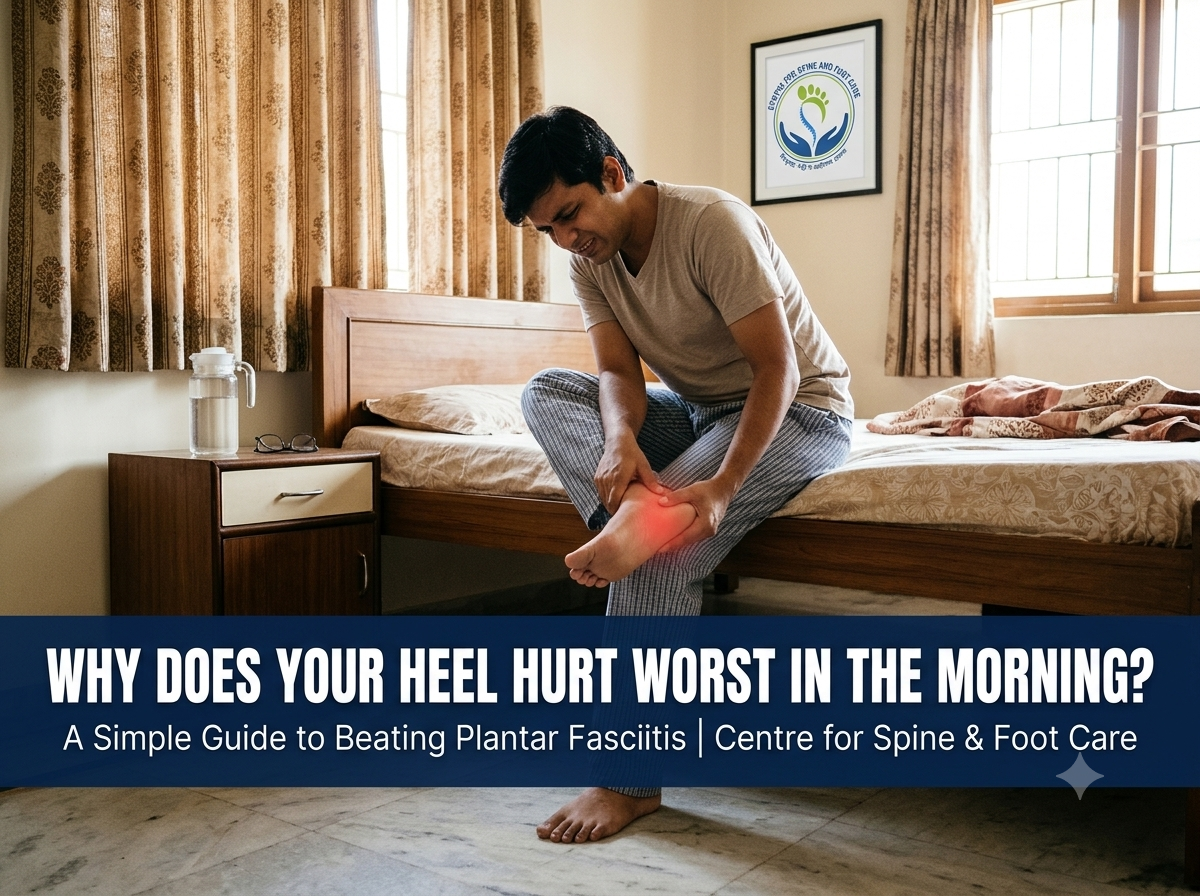
You wake up, swing your legs off the bed, and the very second your heel touches the floor ouch. A sharp, stabbing pain shoots straight through the bottom of your foot, almost like stepping on a nail or a sharp pebble.
You limp to the bathroom, holding onto the wall or bedpost for support. Strangely enough, after ten minutes of walking around, making morning tea, or getting ready for work, the pain softens into a dull ache—only to come roaring back the moment you stand up after sitting at your office desk or driving through Indore traffic.
If this sounds like your daily routine, you are not alone and it is not “just tiredness” or “getting older.” What you are experiencing is the classic hallmark of Plantar Fasciitis, the single most common cause of adult heel pain. Getting evaluated early at a trusted physiotherapy clinic in Indore can stop this morning limp before it turns into a chronic knee, hip, or lower back problem.
What Happens Inside Your Foot While You Sleep?
Think of the bottom of your foot as having a thick, strong rubber band stretched tightly from your heel bone all the way to your toes. In medical terms, this band is called the plantar fascia. Its everyday job is to support your foot arch and absorb shock every time you walk, stand in the kitchen, climb stairs, or go for a morning walk.
When that band gets overworked from standing for hours on hard marble or tiled floors at home, wearing flat chappals without arch support, or suddenly increasing your walking distance tiny micro-tears develop right where the band attaches to your heel bone.
Here is why your very first step in the morning hurts the worst:
- Overnight Tightening: While you sleep, your foot naturally relaxes with your toes pointed slightly downward. Because your foot is resting, that injured band tightens and shortens as it tries to heal.
- The Morning “Snap”: The moment you stand up and put your full body weight onto your foot, that tight, cold band is suddenly yanked straight re stretching those micro-tears and sending a sharp pain signal straight to your brain.
- Post-Sitting Flare-Ups: The exact same tightening happens whenever you sit at a desk or in a car for an hour and then stand up again.
What Verified Medical Data Says About Morning Heel Pain
Before you dismiss heel pain as something that will magically disappear on its own, consider what clinical orthopedic research reveals:
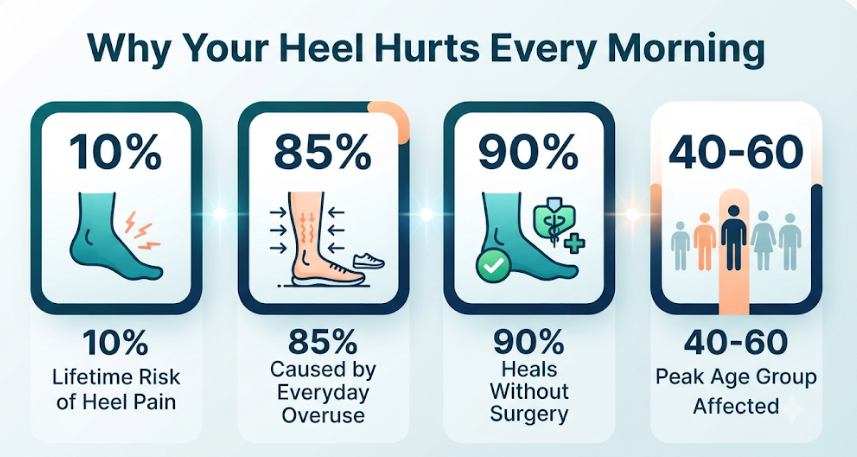
- 1 in 10 People Will Experience It: According to clinical data published by the National Center for Biotechnology Information (NCBI), plantar fasciitis carries a lifetime prevalence of approximately 10% in the general population, making it the leading cause of bottom-of-heel pain worldwide.
- Everyday Routine Is the Biggest Trigger: Roughly 85% of cases have no underlying systemic disease; they are driven by everyday mechanical overload, prolonged standing on hard surfaces, flat footwear, tight calf muscles, and peak age-related tissue stiffness between ages 40 and 60.
- Over 90% Heal Without Surgery: Clinical studies consistently show that more than 90% of patients achieve lasting pain relief through structured, non-surgical conservative care such as targeted physiotherapy, calf stretching, footwear correction, and biomechanical alignment without ever needing surgery.
Why Soft Slippers and Painkillers Rarely Fix the Real Problem
When heel pain strikes, almost everyone tries the exact same three shortcuts: buying extra-soft “ortho” slippers, rolling an ice bottle under their foot, or taking a painkiller before heading to work.
While icing and cushioned slippers calm surface soreness temporarily, they do not fix why your heel is taking excessive pressure in the first place.
Imagine driving a car whose front tyres keep wearing out on the inner edge. You can keep buying new tyres every few months, or you can fix the wheel alignment. Your body works the exact same way:
- If your ankles roll inward slightly when you walk (overpronation),
- If your calf muscles and Achilles tendon are tight from hours of sitting, or
- If subtle pelvic or lower-spine misalignment shifts extra body weight onto one leg,
every single step continues to tug unevenly on your heel—causing the pain to return month after month. If you have been searching online for the best physiotherapy clinic near me, look for a center that examines your entire walking pattern rather than just applying a heat pad to your heel.
How Gait Analysis and Integrated Therapy Fix Heel Pain at the Root
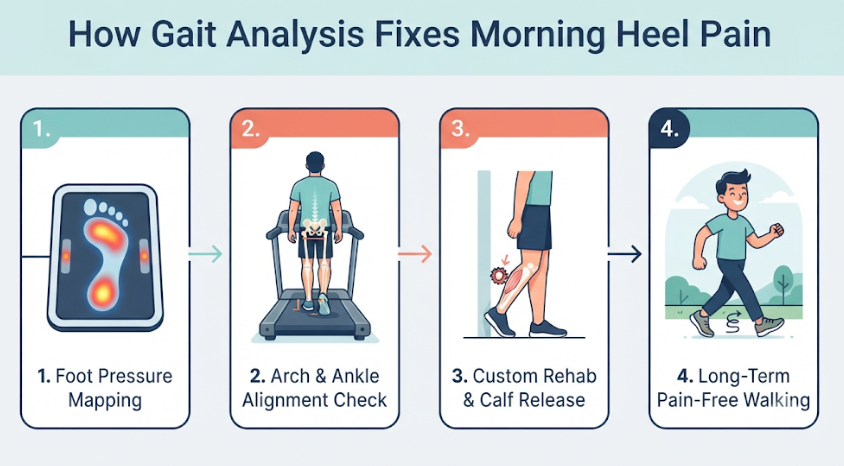
True recovery means looking at how your feet, ankles, knees, and spine work together as one connected chain. At a specialized best physiotherapy center in Indore, treatment combines Gait Analysis, targeted Physiotherapy, and Chiropractic Alignment to eliminate the root stress on your plantar fascia:
- Foot Pressure & Gait Analysis: Specialists observe how your heel strikes the floor, how weight transfers across your arch, and whether you have developed a subtle limp that is straining your knees or lower back.
- Deep Tissue Release & Pain Relief Modalities: Hands-on myofascial release, therapeutic ultrasound or shockwave therapy, and gentle joint mobilization calm inflammation and accelerate tissue healing at the heel attachment.
- Calf & Intrinsic Foot Strengthening: Tight calves pull directly on the heel bone via the Achilles tendon. Targeted stretching combined with strengthening the small stabilizing muscles inside your foot arch offloads the plantar fascia permanently.
- Ankle, Knee & Spine Alignment: When long-term limping throws your pelvis or lower spine off balance, visiting an integrated chiropractic clinic offering evidence-based chiropractic treatment in Indore helps restore proper joint mobility across your ankles, hips, and spine so both feet carry weight evenly.
- Practical Daily Footwear & Home Guidance: You learn simple 60-second stretches to perform before putting your feet on the floor in the morning, along with clear advice on supportive indoor footwear for hard Indian marble and tile floors.
Real Stories From Indore Patients Who Walked Away From Heel Pain
Located in Scheme 140, Centre for Spine & Foot Care (CSFC) helps patients across Indore overcome chronic foot, gait, and spine pain without surgery or lifelong painkillers. For anyone looking for a physiotherapist in Indore near me or the best physiotherapist in Indore for stubborn heel pain, here is what real patients share about their recovery:
“For nearly seven months, I dreaded getting out of bed every morning. The sharp pain in my right heel made walking to the kitchen feel like torture. I tried cushioned slippers and pain sprays, but nothing worked long-term. After a detailed gait assessment and four weeks of targeted foot and calf therapy at Centre for Spine & Foot Care, I finally step onto the floor every morning completely pain-free.”
— Sunita Verma, Homemaker, Scheme 140, Indore
“Standing for 9 hours a day at my store gave me severe heel pain, and soon my lower back started hurting too from limping. The specialists at CSFC explained how my flat arches and ankle alignment were overloading my heel. Their combined physiotherapy and alignment sessions fixed both my heel and my back pain.”
— Amitabh Joshi, Business Owner, Vijay Nagar, Indore
Stop Starting Every Morning With a Limp
Living with morning heel pain does more than ruin the first ten minutes of your day—over time, compensating for a sore heel quietly triggers knee, hip, and lower back pain. If your heel has been hurting for more than two weeks, book a comprehensive foot, gait, and spine evaluation at Centre for Spine & Foot Care, Indore and take your first pain-free step back.
Frequently Asked Questions
1. Why does my heel hurt sharply on my first step in the morning, then feel better later?
Morning heel pain occurs because the plantar fascia—a thick band of tissue supporting your foot arch tightens and shortens while you sleep. When you take your first step out of bed, your full body weight suddenly stretches those micro-injured fibers, causing sharp pain that eases once the tissue warms up.
2. Can plantar fasciitis go away with just soft slippers, or do I need physiotherapy?
Soft slippers only cushion the heel temporarily without fixing tight calf muscles, flat arches, or uneven walking mechanics. Over 90% of plantar fasciitis cases recover without surgery when treated with targeted physiotherapy, stretching, and gait correction.
3. How does gait analysis and chiropractic alignment help chronic heel pain?
Gait analysis identifies how your foot strikes the ground and distributes weight, while physiotherapy and chiropractic joint alignment restore proper mobility across your ankles, knees, hips, and lower spine. Correcting the entire lower-body chain prevents repetitive overload on your heel.
4. When should I visit a physiotherapy clinic in Indore for heel pain?
You should consult a qualified physiotherapist if morning heel pain lasts longer than two weeks, interferes with your daily walking or work routine, or causes you to limp which can trigger secondary knee, hip, or lower back pain.