
Have you ever bought a pair of soft, squishy shoe inserts from a pharmacy or online store, felt great for three days, and then noticed your heel or lower back aching all over again by week two?
You are not alone. Every week at our clinic, we meet runners, teachers, IT professionals, and senior citizens who have drawers full of gel pads and foam inserts—yet they still wake up wincing when their feet hit the floor.
The truth is simple: cushioning is not correction. While readymade inserts offer temporary comfort, fixing chronic pain requires understanding how your feet control the alignment of your entire body—right up to your spine.
Why Your Foot Pain and Back Pain Are Connected
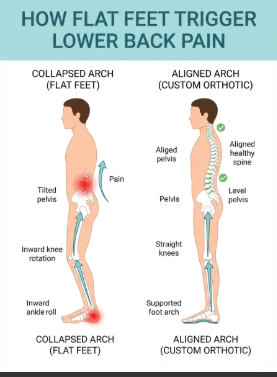
Think of your feet as the foundation of a multi-story building. If the foundation tilts even a few millimeters inward or outward, the walls above it have to twist to stay upright.
In human biomechanics, this is called the kinetic chain. When your foot arch collapses (flat feet) or rolls excessively inward while walking (overpronation), it triggers a chain reaction:
- Your shin bone and thigh bone rotate inward.
- Your pelvis tilts forward to compensate.
- Your lower back muscles work overtime to keep you balanced, leading to chronic stiffness, sciatica-like aches, or disc strain.
According to musculoskeletal research on foot biomechanics published in the National Center for Biotechnology Information (NCBI), altering plantar pressure distribution and rearfoot alignment directly changes joint mechanics in the ankle, knee, and lower kinetic chain. When you treat back pain without checking your feet, you are only painting over cracks in the wall while the foundation keeps shifting.
Readymade Cushioning: What It Does (And Where It Fails)
Store-bought gel pads, memory foam inserts, and generic arch sleeves are widely available and inexpensive. They serve a purpose—just not the one most people hope for.
Where Readymade Inserts Help:
- Short-term fatigue: If you have healthy foot arches and simply stand on hard marble or tiled floors all day, soft foam absorbs minor impact.
- Mild, temporary soreness: For a brand-new pair of stiff formal shoes, basic padding prevents friction and blisters.
Why They Fail for Chronic Pain:
- They compress quickly: Most EVA foam and gel pads flatten out within 4 to 6 weeks under body weight.
- One-size-fits-none geometry: No two people have identical arch heights, heel widths, or gait patterns. A generic bump under your arch can actually push against the wrong part of your plantar fascia, making heel pain worse.
- Zero biomechanical control: Soft cushioning acts like a pillow, not a stabilizer. If your ankle rolls inward when you walk or jog, a squishy pad simply squishes down with it—doing nothing to protect your knees or lower back.
Custom Orthopedic Insoles: Built for Your Exact Biomechanics
Unlike mass-produced inserts, medical-grade custom orthotics are prescribed after a detailed clinical assessment—including foot posture evaluation, plantar pressure mapping, and gait analysis.
Whether you are searching for the best insoles for running to prevent shin splints and heel spurs, or looking for the best insoles for flat feet to stop your knees and lower back from aching after a long shift, precision matters.
How Custom Insoles Actually Fix the Root Cause:
- Targeted Pressure Redistribution: Instead of just adding softness, custom insoles offload high-pressure zones under the heel bone (calcaneus) and forefoot, giving inflamed tissues like the plantar fascia space to heal.
- Dynamic Arch & Rearfoot Control: They hold your subtalar joint in a neutral position during heel-strike and toe-off, stopping the inward collapse that twists your lower spine.
- Shock Absorption Where You Need It: For runners and active adults, selecting the best arch support insoles for flat feet means combining firm structural stability in the midfoot with medical-grade shock dispersion at the heel.
- Long-Term Durability: Made from high-density, multi-layered clinical polymers, custom orthotics retain their corrective shape for 1.5 to 3 years rather than flattening in a month.
Quick Comparison: Readymade Cushioning vs. Custom Orthopedic Insoles
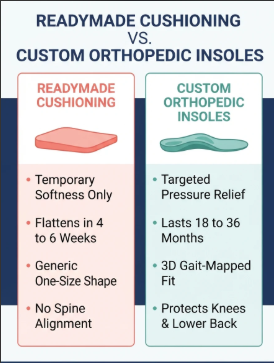
| Feature | Readymade Cushioning (Store-Bought) | Custom Orthopedic Insoles (Clinic-Fitted) |
| Primary Goal | Temporary softness & comfort | Biomechanical alignment & pain resolution |
| Fit & Sizing | Standard shoe sizes (S, M, L) | Molded/calibrated to your exact 3D foot scan & gait |
| Effect on Spine | Minimal to none | Reduces pelvic tilt & compensatory lower back strain |
| Ideal For | Mild foot fatigue in healthy feet | Chronic heel pain, plantar fasciitis, flat feet, back pain |
| Lifespan | 1 to 3 months | 18 to 36 months |
Who Benefits Most From Custom Insoles?
- Runners & Gym Enthusiasts: High-impact activities multiply ground reaction forces by 2.5 to 3 times your body weight. Properly calibrated orthopedic insoles for flat feet prevent overpronation, Achilles tendinitis, and runner’s knee.
- Working Professionals (Teachers, Surgeons, Retail & IT Staff): Long hours standing on hard surfaces or sitting with poor posture strain both the plantar fascia and lumbar spine.
- Senior Citizens: As we age, the natural protective fat pad under our heel thins out, and arches gradually flatten. Custom insoles restore lost shock absorption, improve balance, and reduce fall risk.
- Diabetic Patients: Custom off-loading insoles prevent dangerous pressure points, calluses, and foot ulcers.
Stop Guessing With Your Feet and Spine
If your heel pain or lower back ache has lasted more than two weeks, buying another pair of off-the-shelf shoe pads won’t solve it. Pairing targeted physiotherapy (like myofascial release, calf stretching, and core stabilization) with clinically fitted orthotics addresses both your symptoms and the mechanical habits causing them.
Ready to find out what your feet are doing to your back? Visit Centre for Spine and Foot Care in Indore for a comprehensive biomechanical foot and spine assessment, and step into lasting, pain-free movement.
Proven Results: How Custom Orthotics Impact Your Spine and Feet
You can display these highlights in a sidebar box or reference section on your blog:
- Biomechanical Link to Back Pain: Clinical podiatry and biomechanics data shows that abnormal foot mechanics—such as collapsed arches (flat feet)—alter gait and pelvic alignment, contributing to strain in over 50% of chronic lower back pain cases.
- Pain Reduction With Orthotics: A 2023 systematic review and meta-analysis of adults with symptomatic flexible flat feet confirmed a statistically significant reduction in pain when using structured foot orthoses compared to non-supportive controls.
- Rearfoot & Joint Control: A 2024 systematic review and meta-analysis found that properly contoured foot orthoses significantly improve peak rearfoot eversion, ankle mechanics, and knee joint moments during walking.
- Footwear & Orthotic Impact: Clinical studies indicate that combining supportive footwear with proper orthotic alignment can reduce chronic foot and lower back discomfort by 30% to 42%.
Patient Testimonials (Ready to Embed on the Blog Page)
“I spent thousands on expensive running shoes and gel insoles for my morning heel pain, which eventually triggered sciatica in my lower back. After a gait analysis and custom insole fitting at Centre for Spine and Foot Care in Indore, my morning pain dropped by 80% in three weeks. I’m back to my 5K runs pain-free.”
— Rohan M., 34, IT Professional & Recreational Runner (Indore)
“Standing for 6 hours a day as a school teacher gave me unbearable heel and lower back ache. Doctor explained how my flat feet were pulling on my spine. My custom insoles fit right into my daily footwear, and I can finally finish my classes without limping.”
— Sunita S., 48, Senior Teacher (Indore)
“At 66, walking even 15 minutes hurt my heels and made my lower back stiff. The team designed soft yet supportive orthopedic insoles tailored to my feet. My balance feels much steadier now.”
— Rajeshwar K., 66, Retired Bank Manager (Indore)
Frequently Asked Questions (FAQs)
1. Can flat feet really cause lower back pain?
Yes. When your foot arch collapses inward while standing or walking, it causes your lower leg and thigh to rotate inward. This shifts your pelvis out of neutral alignment and forces your lower back muscles and spinal joints to absorb extra stress with every step.
2. Are soft gel insoles good for plantar fasciitis and heel pain?
Soft gel insoles may feel comfortable for a few days, but they lack structural arch support. Because they compress easily under body weight, they do not stop the plantar fascia ligament from overstretching, which is why heel pain usually returns.
3. How do I choose the best insoles for running if I have flat feet?
Runners with flat feet need dynamic arch control combined with heel shock absorption rather than pure foam. A clinical gait analysis helps determine how much your ankle rolls inward (overpronation) so your orthopedic insoles support your arch without restricting natural push-off.
4. How long does it take to get used to custom orthopedic insoles?
Most patients adapt within 5 to 10 days. Because custom insoles gently realign your foot, ankle, and posture, we recommend wearing them for 2–3 hours on day one and gradually increasing wear time over the first week.
5. Can I move my custom insoles between different shoes?
Yes. Full-length and three-quarter custom insoles can easily be transferred between walking shoes, running sneakers, and formal office footwear, provided the shoes have removable factory liners and adequate depth.