
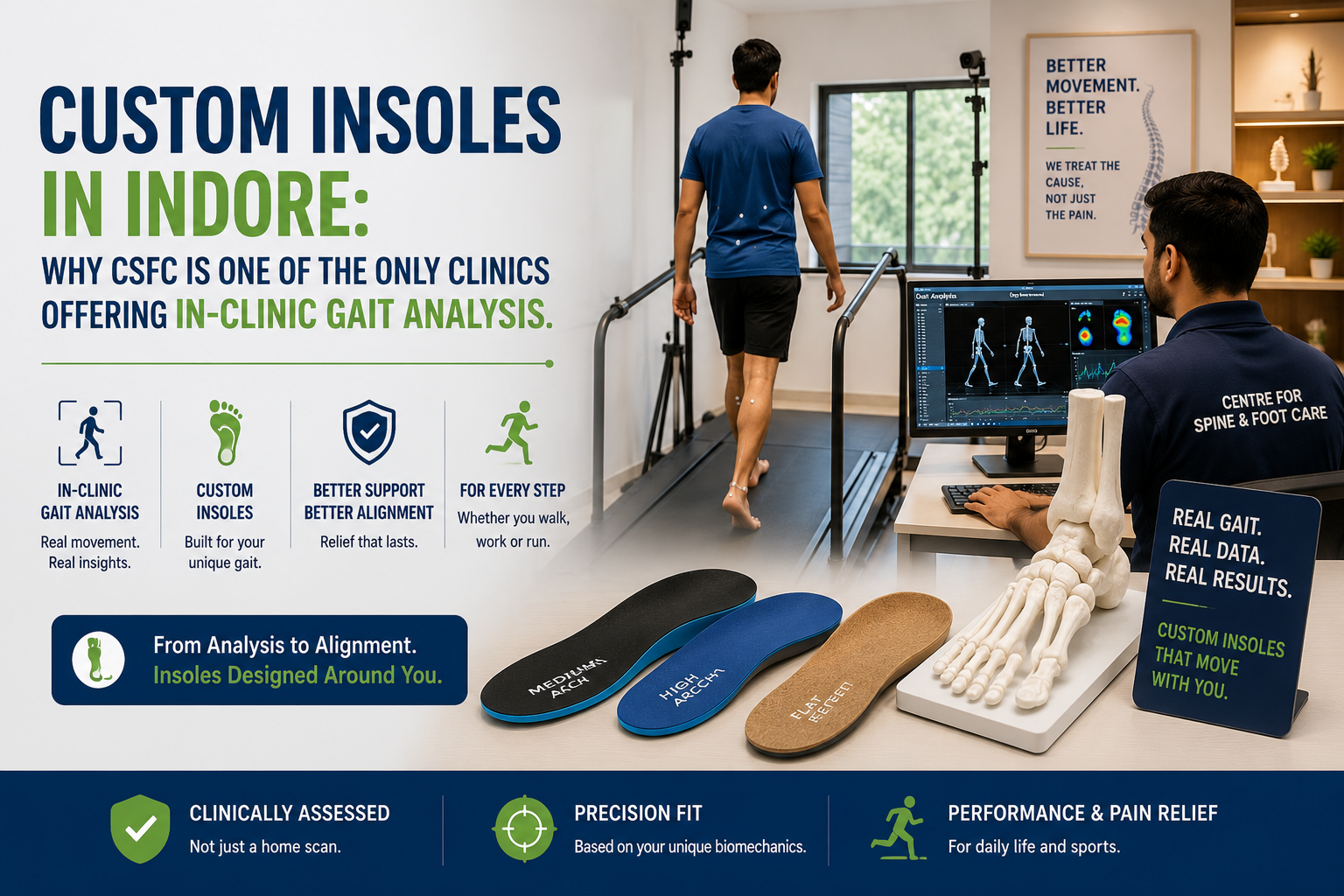
If you’ve searched for the best insoles for flat feet or the best arch support insoles for flat feet, chances are you’ve landed on dozens of online stores selling insoles based on a home foot scan or a quiz. What most of these skip entirely is the one thing that actually determines whether an insole works: how your foot behaves while you’re walking or running, not just how it looks standing still.
That’s the gap Centre for Spine and Foot Care (CSFC) fills in Indore — as one of the only clinics in the city offering genuine in-clinic gait analysis alongside custom insole fitting.
What Makes In-Clinic Gait Analysis Different
Home-scan insole brands typically rely on a static 3D scan or a photo of your foot at rest. That tells you the shape of your arch — but not how your foot actually moves, rolls, or absorbs impact when you walk or run. Research on flatfoot biomechanics has shown that arch support insoles measurably change ankle and knee movement patterns during actual gait, not just static foot shape — which is exactly why a real walking or running assessment matters more than a snapshot.
A 2026 study on orthotic insoles and gait biomechanics in runners with flatfoot, published in the Scandinavian Journal of Medicine & Science in Sports, found that arch support insoles measurably change ankle and knee movement patterns during actual gait — not just static foot shape — which is exactly why a real walking or running assessment matters more than a snapshot.
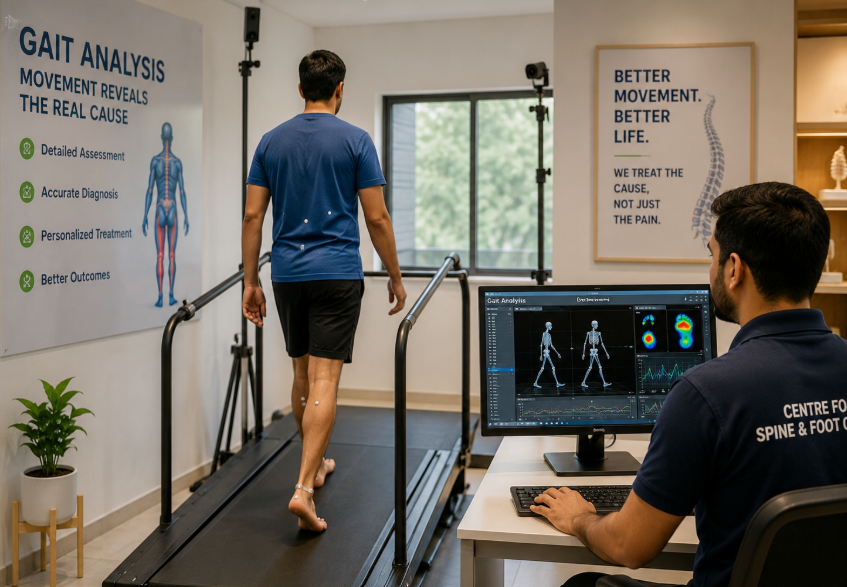
At CSFC, gait analysis is done in person: a clinician observes posture, foot strike pattern, pronation, and joint alignment while you walk or jog, then designs orthopedic insoles for flat feet or other conditions based on that real movement data — not a guess based on a 2D photo.
Best Insoles for Flat Feet vs Best Insoles for Running
Not every insole need is the same, and this is where a lot of generic insole shopping goes wrong.
For flat feet: The priority is arch support that controls excess pronation — the inward rolling of the foot that can cascade into knee, hip, and lower back strain over time. Orthopedic insoles for flat feet are built to stabilize the arch through the full stance phase of walking, not just cushion the heel.
For running: Runners need something different — insoles that manage repeated impact loading, control pronation during faster gait cycles, and hold up under sustained mileage. The best insoles for running are typically firmer through the arch and shaped around the runner’s specific strike pattern (heel, midfoot, or forefoot), which is only identifiable through gait observation, not a resting foot scan.
This is precisely why CSFC treats flat-feet insoles and running insoles as two different assessments rather than a one-size-fits-all product — because the biomechanical demands are genuinely different.
Why CSFC’s Process Stands Apart in Indore
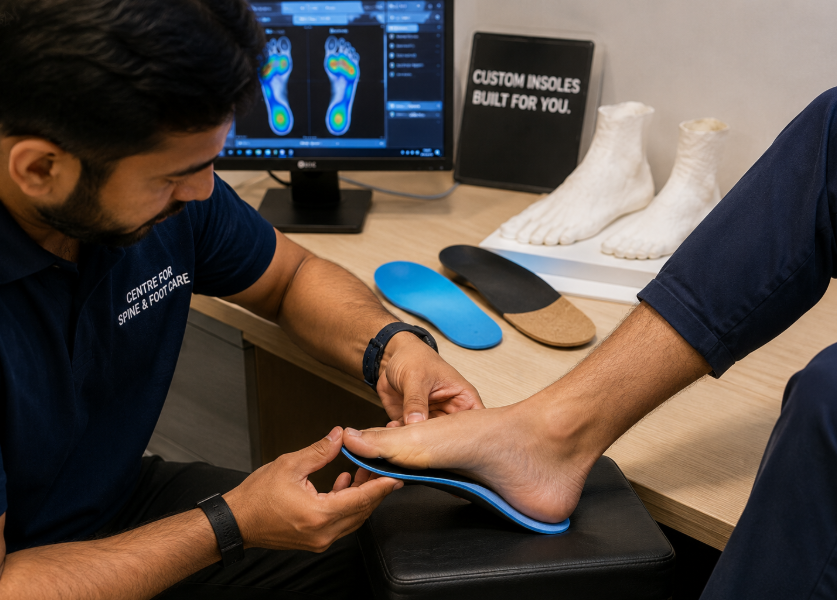
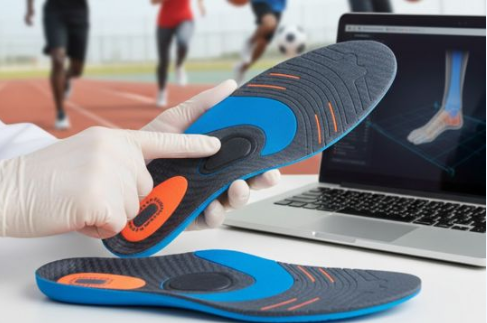
Most insole options available to Indore residents fall into one of two categories: generic over-the-counter inserts sold at pharmacies, or D2C brands that ship a product based on a home scan with no clinical follow-up. CSFC’s in-clinic model closes that gap — combining a hands-on gait assessment with iterative fitting, so insoles are adjusted based on how they actually perform once you’re walking or running in them, not just how they look on a screen.
The Numbers Behind Foot Mechanics
Flatfoot-related gait issues are more common than most people assume, and studies consistently show that insole design meaningfully changes ankle and knee coordination during walking — with measurable improvements when insoles are matched to actual gait behavior rather than static foot shape alone. This is the clinical rationale behind why an in-person assessment produces a more reliable outcome than a home-based scan.
What Patients Say
“I’d bought two different online insoles before visiting CSFC, and neither helped my running knee pain. Watching them actually analyze how I run — not just scan my foot — made the difference. The insoles they built fit exactly how I move, not just how my foot looks standing still.” — CSFC Patient
Conclusion: Why Gait-First Insoles Matter More Than a Quick Fix
Insoles bought off a shelf or shipped after a home scan can feel like a fast solution, but foot pain, running discomfort, and posture-related strain rarely respond to a generic fix. The real value of an in-clinic gait analysis is that it treats the insole as part of a diagnosis, not a standalone product — accounting for how your foot actually strikes the ground, rolls, and loads across a full walking or running cycle, rather than just its shape at rest.
This is why CSFC’s approach to orthopedic insoles for flat feet and the best insoles for running starts with observation, not assumption. Whether the goal is relieving arch pain,we customise best arch support insoles for flat feet,at CSFC correcting pronation, or supporting a runner through higher mileage, matching the insole to real movement data produces outcomes that generic options simply can’t replicate.
Clinical research continues to reinforce this point — a systematic review on foot orthoses published in the British Journal of Sports Medicine found that properly fitted orthotic devices can meaningfully reduce the risk of certain lower-limb injuries when matched to an individual’s biomechanics. That evidence is exactly why an assessment-led approach, not a one-size-fits-all product, remains the more reliable path to lasting relief.
If foot, knee, or running-related discomfort has been a recurring issue, an in-clinic gait assessment is worth exploring before reaching for another off-the-shelf insole.
FAQs
Q1: What’s the difference between a home foot scan and in-clinic gait analysis?
A home scan captures your foot’s shape at rest. In-clinic gait analysis observes how your foot moves and loads during actual walking or running, which is what determines whether an insole will genuinely help.
Q2: Are orthopedic insoles for flat feet different from running insoles?
Yes — flat-feet insoles focus on arch stabilization during standing and walking, while running insoles are built around impact absorption and strike-pattern support at higher speeds.
Q3: How do I know if I need arch support insoles?
Signs include arch or heel pain after standing or walking, knee or lower back discomfort with no clear injury cause, and visibly flattened arches — a gait assessment can confirm the specific issue.
Q4: Can custom insoles help with running injuries?
Yes, when properly fitted based on gait analysis rather than a static scan, insoles can help manage pronation and impact-related strain that often triggers running injuries.
Q5: Do I need a referral to get a gait analysis at CSFC?
No — you can book a gait analysis and insole consultation directly.